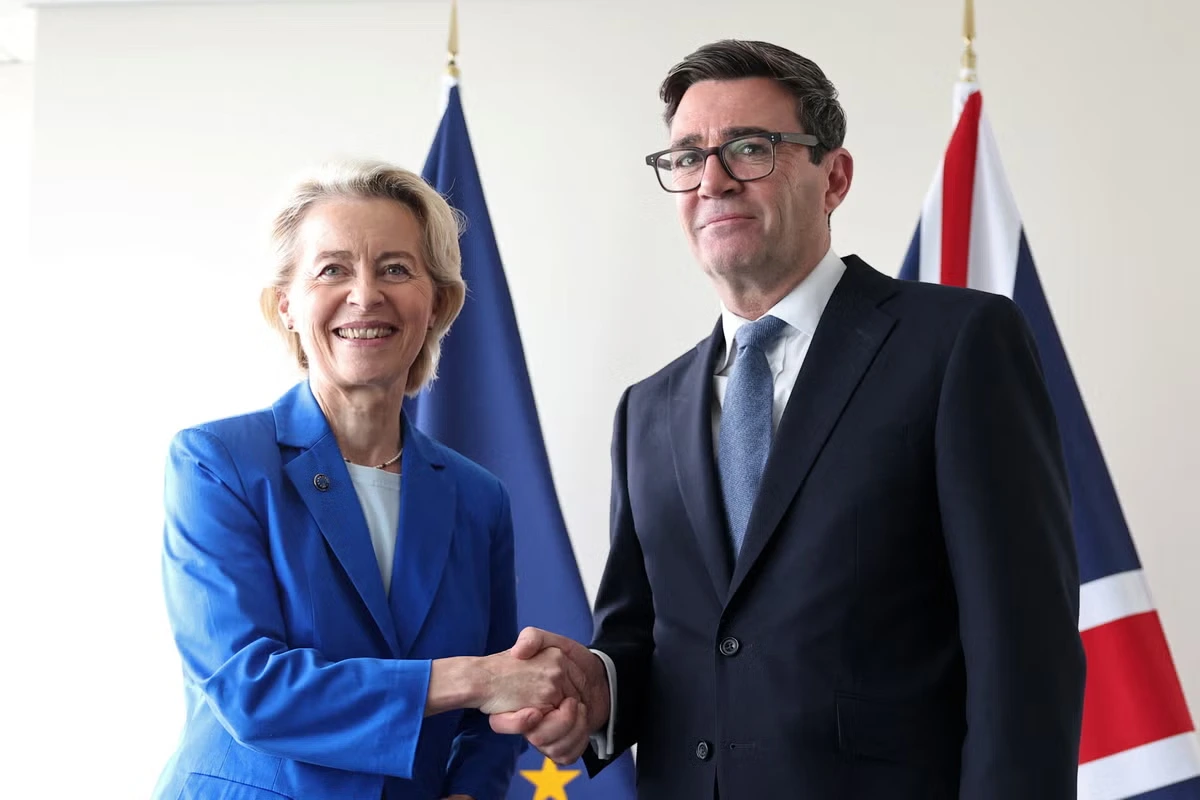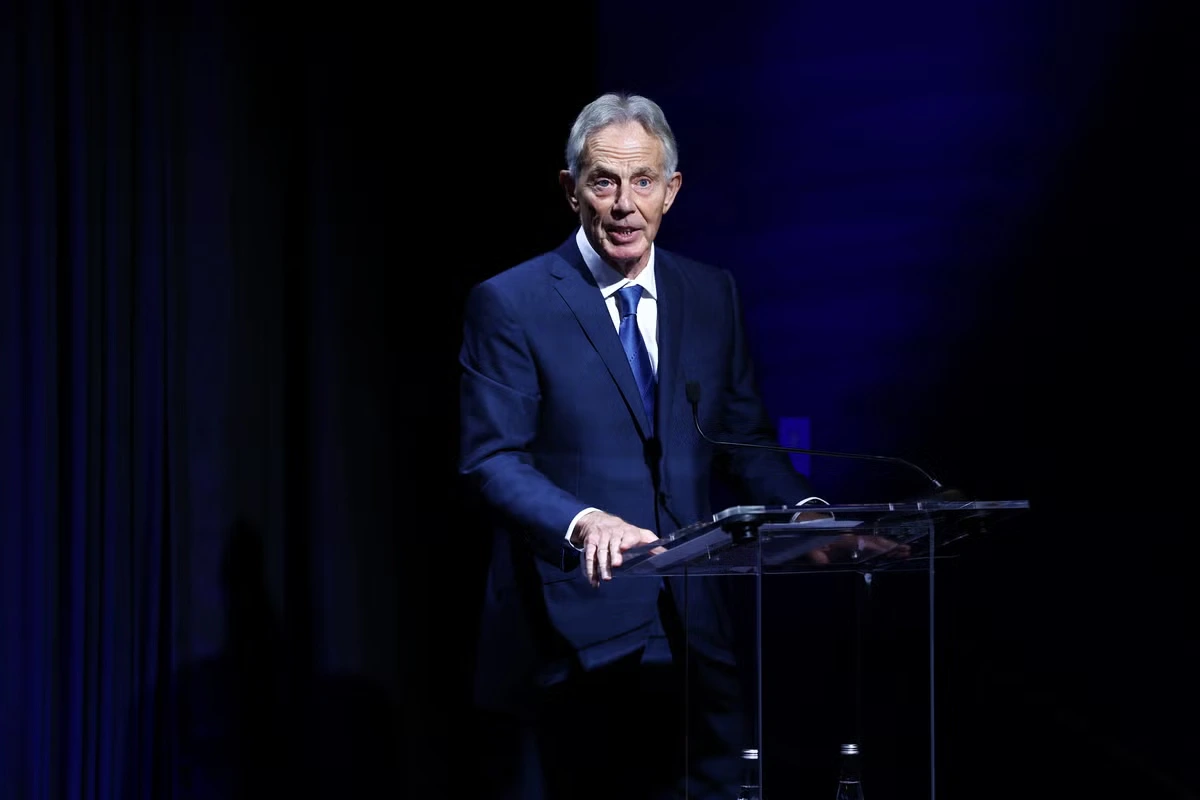
Sir Tony Blair has told Andy Burnham that Britain should commit to rejoining the European Union within the next 10 years, as he called for a “new approach” to post-Brexit ties.
The former prime minister urged Mr Burnham to demand a “structured relationship” with the bloc and abandon Sir Keir Starmer’s piecemeal approach to Britain’s ties with the EU, which he described as “inching towards” Europe as a result of public opinion.
However, the former Labour leader said it would be wrong to return to a straight membership of the single market and customs union, and said Mr Burnham should instead seek to rejoin a “significantly reformed” EU, along with reforms inside the bloc, which could see Europe as a superpower that could challenge the US and China.
The intervention from the former prime minister adds to growing pressure on Mr Burnham to prioritise a new relationship with Europe and give serious consideration to the possibility of rejoining the EU.
On his recent trip to New York, the prime minister failed to rule out including a commitment to rejoin the EU in the next Labour manifesto when questioned by The Independent.
It also came as a report by the Institute for Public Policy showed that £6.5bn a year was being lost in exports to the EU because of a failure to have mutual recognition of standards while YouGov polling for Best for Britain highlighted that Labour’s best chance to win the next election is to include a commitment to rejoin.
With a major debate on rejoining the EU set to take place in parliament on 12 October, a letter writing campaign coordinated by the European Movement UK supporting the petition behind the debate has passed 20,000.
Sir John Curtice, Britain’s leading pollster, told The Independent earlier this month that support for rejoining the EU is at its highest point since the 2016 referendum, while a separate analysis published last week found that all but four of the 632 constituencies in Great Britain would support returning to the bloc.
Highlighting his demands for a rethink on Brexit, Sir Tony wrote in the foreword to his think tank’s report titled Beyond Leave and Remain: A Path to Rejoining a Reformed Europe: “We should be clear that we want back into a formal relationship with the EU. But it must be a Europe on a credible path to reform, a Europe of nation states, a Europe capable of being a genuine global power.”
The report continued: “Britain should play a leading role in shaping a more powerful Europe. The necessary reforms have already been identified – not least in Mario Draghi’s report on EU competitiveness – but implementing them remains the challenge.
“For Britain to be part of that effort, it must show political commitment to Europe. This can be achieved by setting a clear, public objective to rejoin the EU within a decade – subject to internal EU reform.
“This objective should be a cornerstone of the UK government’s upcoming 10-year plan.”
Sir Tony added that the EU’s decision to invite Canada to become an ‘associate member’ showed a “newfound flexibility” in relations between the EU and non-member states.
The report also calls for a robust staged return to the EU with deals on defence, energy and technology.
Proposals include rejoining the EU's €150bn SAFE defence fund; creating a new European Energy Security Partnership with the North Sea becoming a shared energy hub, and reconnecting to EU electricity markets saving British billpayers up to £370m a year; and joint work on checking AI systems are safe and on frontier technologies like quantum computing.
The report also argued: “Europe's biggest problem isn't a lack of institutions but a lack of delivery. Britain should help turn the European Political Community from a forum for dialogue into a working one for power, pulling together willing countries to get things built and done.”
Author of the report, the TBI's Director Tone Langengen, said: "Europe reorganised itself around peace after the Second World War, and around integration after the Cold War. Now it must reorganise around the condition of today - power.
“Countries are competing to secure the capabilities that will underpin influence in the 21st century. Britain should help lead that shift, building up its power in defence, energy and technology, working with Europe as an equal partner, not refighting the arguments of 2016."
The Tony Blair Institute (TBI) report came as another influential think tank, the Institute for Public Policy Research (IPPR), published a damning report into the economic damage caused by Brexit, highlighting a lost of £6.5bn of exports for failing to have a mutual recognition agreement in goods.
The two reports have added to overwhelming pressure to revisit Brexit and reverse it as MPs prepare for a major debate on 12 October when parliament reconvenes.
The IPPR found that UK exports to the EU could have been £6.5 bn a year higher alone if there had been mutual recognition agreement rather than a hard Brexit.
An EU-UK deal recognising each other's product testing could have boosted goods exports by between £3.7bn and £6.5bn a year, the thinktank found, with automobiles, electronics, and pharmaceuticals would have benefited most.
Joseph Sassoon, economist at IPPR and co-author of the report, said: “Since Britain left the EU, thousands of products that are made and certified in the UK have to be tested and certified by EU bodies before they can be exported.
"At a time when growth is hard to come by, a mutual recognition agreement with the EU would be a practical way to boost trade and support key sectors of the UK economy.”
Meanwhile, a YouGov across a sample of almost 14,000 GB adults in every constituency in England, Scotland and Wales commissioned by Best for Britain showed that a commitment to EU membership could secure Labour 321 seats on central estimates, five short of an absolute majority, and douse any threat of a hung parliament with Reform UK holding the most seats.
Commenting on the IPPR report, Tom Brufatto, executive director of policy and research at Best for Britain, which campaigns for the UK to restore its EU membership to get the economy back on track, said: “Everything points to there being little scope to further deepen UK-EU relations without revisiting the UK Government’s red lines. Only full EU membership can grow the UK economy by at least £92bn per year, and it is supported by a majority of the electorate, particularly Labour’s coalition of voters.”
Naomi Smith, chief executive of Best for Britain, added: “The UK was a liberalising voice in the EU, and it must be once again, helping to reform it from the inside, not waiting idly on the margins for a decade. That would be like saying you'll only join the team once they've won the league, and Britain’s economic outlook isn’t exactly looking match fit.”
Mike Galsworthy, chair of the European Movement UK, which is pushing supporters to write to their MPs demanding a Brexit rethink, said: “Everyone seems to be realising that the UK joining the EU is the only sensible plan going forward.
“Maybe it's because we're watching the Commonwealth and Europe coming together without us, maybe it's because the East-West vice of Trump and Putin is forcing us into European teamplay, or maybe it's because Brexit's 40 million pieces of paperwork per annum are squashing the life out of our exporters and importers.
“Either way, it's abundantly clear now that the world is reshaping fast. We need to climb out of the Brexit spider hole and actually take up our place at the heart of European and Commonwealth countries coming together. Joining the EU anew is the future and it's an increasingly exciting one."
What you will get by joining:
There are even more benefits if you subscribe for just £1 for seven months: